
One of our Two Seaters we operate here at Flyaspitfire.com, Spitfire MJ627 has rich a Wartime history, and September marks 81 years since she entered service with 441 Squadron Royal Canadian Air Force.
Spitfire MJ627 was built at Castle Bromwich in the Autumn of 1943 as a LF Mk IXc, first flying on the 27 November 1943. She was stored at 9 MU at Cosford, till the spring of 1944. MJ627 entered service into 441 Squadron RCAF on 25th September 1944 serving with the RAF from B-70 Advanced landing ground in Belgium, with the codes ‘9G-Q’.
25th September 1944:
Her first sortie on 25/09/44, was a Patrol over Nijmegen at 10:45am flown by F/L A. A. Smith along with 7 other Spitfires which ended up being an Unsuccessful patrol. On the same day MJ627 saw another Patrol of the Nijmegen area, this would be 627’s first patrol with enemy aircraft. P/O B.W Dunning at the controls of MJ, with another 9 Spitfires, they departed from B-70 landing ground at 14:35, and spotted 30+ Me 109’s with Focke Wolf 190’s which were carrying a bomb load. The Enemy aircraft were encountered about to attack the Nijmegen Bridge.
The Spitfires entered into a Dog fight with the Me-109’s, but the FW-190’S were forced to Jettison their bombs, and the bridge was not attacked. But throughout this successful patrol, 3 Me-109’s were shot down with another 5 damaged. The final patrol of the day saw MJ participate in an evening patrol, at 17:35 9 Spitfires Escorted seven C-47 Dakotas into Arnhem, to supply the troops on the ground for Operation Market Garden. All of the Dakotas successfully dropped their supplies. F/L Lake flying Spitfire PL272, shot up 3 Flak posts at Arnhem which were firing at the Dakotas, strikes were seen, and guns ceased fire, and the aircraft returned to base at 19:00.
26th September 1944
Tuesday 26th September 1944 saw MJ627’s involvement in a morning patrol at 10:00am piloted by P/O B.W Dunning. Spitfires Departed from B-70, they patrolled the Nijmegen area with sightings of an ME-262 at 5,000ft, they attempted to engage with the Enemy, but the jet broke away at high speed. The squadron saw another uneventful patrol at 13:00, and another patrol 16:00 with the Squadron engaging in another dogfight over Nijmegen. 8 Me-109’s were seen over circling at 15,000ft, Spitfires engaged and F/O McIntosh flying NH176 was hit by cannon fire making a successful forced landing in Eindhoven. The wing commander of 125 Wing, W/C A. C. Page destroyed one Me-109, strikes were seen on two other Me-109’s, but no one could claim them until the results could be confirmed by cine film, landing back at base by 17:40.
27th September 1944
On Wednesday 27th September 1944, The Squadron were tasked to Patrol the Arnhem area, with 12 Spitfires taking off from Belgium at 06:55am, this day MJ627 was piloted by P/O Sid Bregman. At the Height of 6000ft, fifteen Me 109’s and Focke Wolf 190’s were seen flying 10 miles East of Arnhem. Spitfires engaged in a Dog fight, F/L Lake in MK967, F/L J.C. Copeland in PL272 and P/O S. Bregman in MJ627, each destroyed a Messerschmitt Me-109, without the loss to themselves. The cine film confirmed Bregman’s Me-109 credit, and the original film lies with the Imperial War Museum.
P/O Sid Bregman’s Personal account of the Me 109 from 27th September 1944
“On September 27 1944, we were patrolling the area around Arnhem, as a squadron. We all had special long-range tanks on the underside of our aircraft, which gave us some additional range, because we were stationed at Antwerp at the time. Normal range was 80 to 90 minutes at the most. Those tanks gave us an extra hour.
In any case, while we were patrolling over Arnhem, my engine stopped. Obviously the tank had fallen off, so I switched immediately. That particular manoeuvre put me in a position somewhat astern of the rest of the squadron, although my wingman was still with me.
As I looked over my shoulder, lo and behold, there was an Me 109 alone, with me now very manoeuvrable because I didn’t have that tank. It took about two or three seconds for me to get in line, and another second or two after that I hit the 109.
That was the end of it – it only took 11 shells altogether. Just a quick burst and it went down immediately. Because I’d lost the tank, I got permission from the squadron leader to head back to Antwerp. My victory was confirmed later by Don Kimball. Apparently, the 109 crashed into the Rhine at Arnhem. We had done a lot of air-to-ground, but that was my first German aircraft. ”

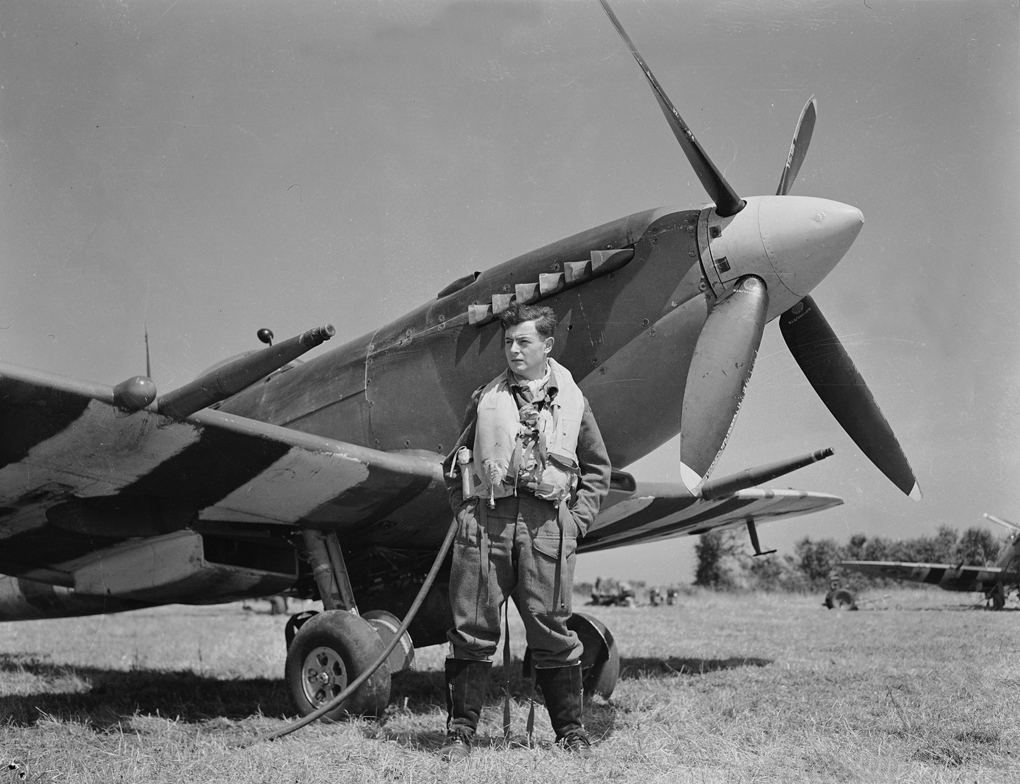
P/O Sid Bregman pictured in front of MJ627 9G-Q at B-70 landing ground in Belgium. September 1944
28th September 1944
Thursday 28th September saw two uneventful patrols of the Nijmegen area, a morning patrol at 07:15 with P/O F.E Monette piloting MJ, returning at 08:30. A Second Uneventful patrol piloted by P/O S. Bregman departing at 11:00 and returning at 12:40. Later on that day at 17:00, P/O F.E Monette at the controls, 12 Spitfire’s carried out an Armed Recce and Sweep at Geldern – Munchen – Gladbach however the Enemy was reported but not seen.
29th September 1944
Friday 29th September MJ627 took part in another Armed Recce, at Utrecht – Amersfoort – Appeldoorn, very little was seen due to poor weather. The Recce was therefore uneventful, and Spitfires returned to the airfield at 10:30.
30th September 1944
Saturday 30th September, saw MJ627’s last sortie from B-70 landing ground, with P/O S. Bregman at the controls. 6 Spitfires including MJ, took off at 9:30 to patrol the Nijmegen area. 15 Miles East of Nijmegen, two Me 262’s were spotted at 9,000ft. F/L Lake at the controls of PL272, damaged one of the 262’s. One of the 262’s was gliding down in a shallow dive and one was carrying a yellow bomb about 1,000lbs. The bomb appeared to be slung off centre underneath the fuselage. F/L Lake saw the enemy coming in at 10 o’clock and turned to starboard in an attempt to get around the tail of the Me 262, the other 262 turned port and was lost in cloud. F/L Lake fired a burst at the enemy from an angle around 60 to 90 degrees as it went by, his range was between 100 and 200 yards.
A piece the size of an aircraft panel was seen to fall from the axis aircraft, F/L Lake, continued his turn and got onto the tail of the 262 Jet, but it pulled away rapidly at speed, approx 450 MPH, during this time the Axis aircraft turned on jet units, as a black vapour was spotted, and the enemy disappeared into the cloud. The ME 262 took no evasive action other than speed, it was painted light underneath and dark on top, with the bomb still attached. All 6 Spitfires returned to base at 11:00.
Afternoon of 30th September
On the Afternoon of the 30th September, 441 Squadron Spitfires took off from B-70 for the last time and headed to RAF Hawkinge their new base. All those who could not fly the Spitfires were taken back by Dakota. Throughout the Month of September 441 Squadron completed 412 Operation sorties and 593 hours on Mk IX b Spitfires.
Her continued War History
From October 5th, 1944 to 24th December 1944 MJ627 operated with 441 Squadron from RAF Hawkinge, Kent. MJ627 escorted Halifax, Lancaster and Boston bombers into Holland and Germany with a total of 21 Combat missions completed by December 1944, before moving to the Orkney Island for defence of the Naval fleet. Then onto Manston in Mid 1945 with No1 Squadron.

Sold to Vickers Armstrong in 1950 for conversion to a T9 Two-Seater, and later sold to Irish Air Corps as IAC 158 and delivered to Baldonell near Dublin in 1951, withdrawing in 1960.
MJ627 is a truly historic aeroplane which we are proud to operate here at Flyaspitfire.com for experience flights along with our other fleet of Two Seat Spitfires. MJ627 wears the same paint scheme and squadron codes as she wore the day she claimed a victory, on 27th September 1944, 81 years ago.
P/O Sid Bregman survived the war, sadly passing away in 2014.

MJ627 today at Biggin Hill as operated by flyaspitfire.com
Read more about MJ627 here: https://flyaspitfire.com/aircraft/1943-spitfire-t-9-mj627/